

If I ask you to estimate your future spending, what comes to mind? For most, it’s inflation. It seems like a reasonable guess that our personal spending will increase in line with aggregate price levels. Or maybe with healthcare costs growing the way they have, one might guess our late-in-life spending grows even higher than inflation. Also seems plausible.
In another prediction exercise, in a 2000 study, Cornell students were asked to wear a T-shirt with an image of Barry Manilow around other students, the idea being such a T-shirt would be embarrassing (while not a particular fan of his work, I feel compelled to stick up for Mr. Manilow, but what’s done is done).1 The Manilow-donning students were asked to predict what percentage of other students would notice the T-shirt. The average prediction was around 50%. By contrast, upon interviewing the observing students, roughly 20% of them had recalled the T-shirt.
My point in bringing up the Great Manilow T-shirt Experiment (my naming) is to highlight just one very quirky example of how bad we humans can be at predicting outcomes in the absence of data. Turning back to lifetime spending expectations, it turns out that assuming your spending will increase with inflation indefinitely is akin to assuming 50% of people are going to notice your Barry Manilow T-shirt; the observed data suggest numbers much smaller than you expect. And that has very serious and meaningful implications, namely that you may be risking OVER-saving and not enjoying your money both during your working life and during retirement.
In this article, we’re going to review typical spending patterns throughout life, and we’ll see that lifetime spending, rather than climbing steadily forever, tends to follow an arc-like pattern, peaking in middle age and generally declining thereafter. We’ll discuss the implications of this, not only on your retirement but also on how you live your life until then.
The Arc of Lifetime Spending
The Bureau of Labor Statistics publishes consumer expenditure data based on annual household surveys. Annual data is available from 1984-2024, and the chart below shows average household spending by age group at five snapshots in time: 1984, 1994, 2004, 2014, and 2024.2
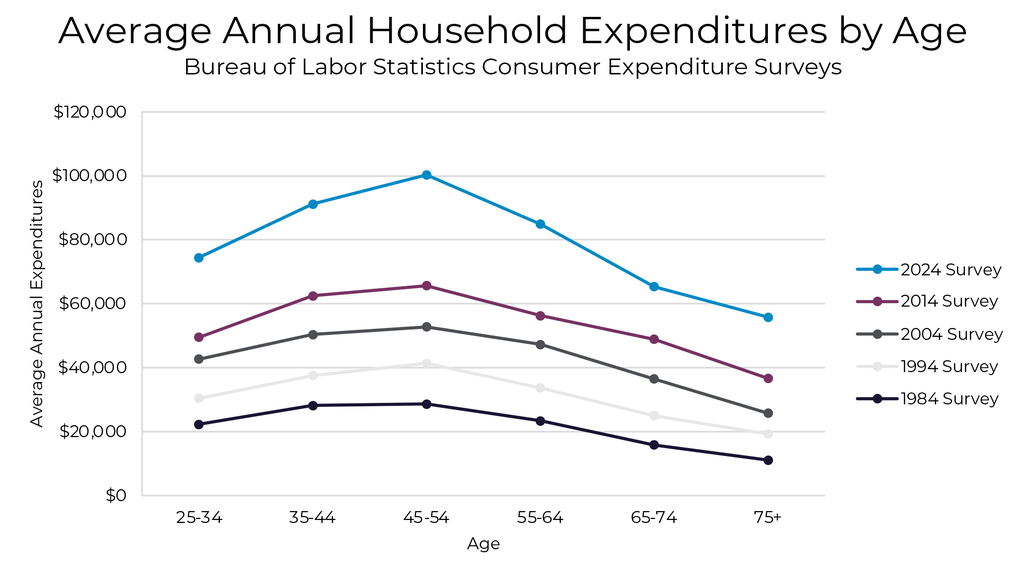
While spending levels across the board have increased with inflation, the shape of the curve is remarkably similar at each point in time, even while lifestyles have changed. People in their 40s and 50s spend the most, and the number declines from there into older age. The underlying composition of spending is somewhat predictable. By middle age, households are spending a lot on housing — perhaps they’re out of a starter home or apartment and in a larger home with a bigger mortgage and bigger bills. They’re spending a lot on transportation, traveling more and perhaps owning an extra car for teenage drivers. And they’re paying a lot toward insurance and pension/retirement, making hay during those high-earning years to pad retirement. Those spending buckets all generally decrease with age after that point. The only consumption buckets that increase materially in absolute terms are healthcare and cash contributions (gifts and charitable donations), but the increase in those categories is more than offset by decreases elsewhere.3 Regardless of the underlying composition, the arc-like trend is very robust, and it appears to continue into the retirement years.
What About After 75?
According to the actuarial longevity calculator (sidebar: I used to be an actuary, which might explain my winning personality), an average-health, non-smoking 75-year-old male has a 36% chance of living to age 90+, and a similar female has a 47% chance of living to 90+.4 Given such high probabilities of living beyond age 90, one might wonder whether the average within the “75+” bucket is masking a trend at more advanced ages.
Not really, it turns out. Spending typically continues to decline through the end of one’s life, and several studies have shown this. One such study by Frederick Vettese examined this pattern for pension planning for Canadian retirees.5 Through a combination of his own research and aggregating several other studies, Vettese examined retirees' spending patterns in four developed countries: Canada, US, UK, and Germany. The results were all remarkably similar. Consumption decreased throughout life. He summarized the approximate spending changes as follows:
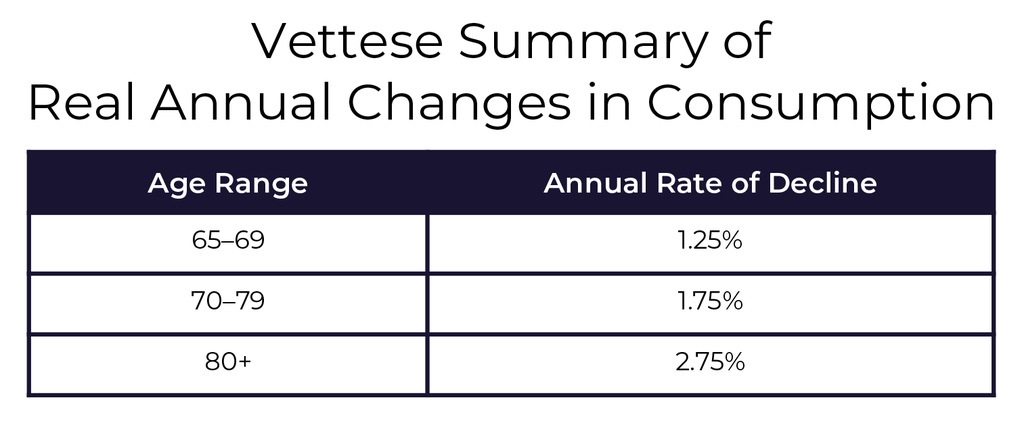
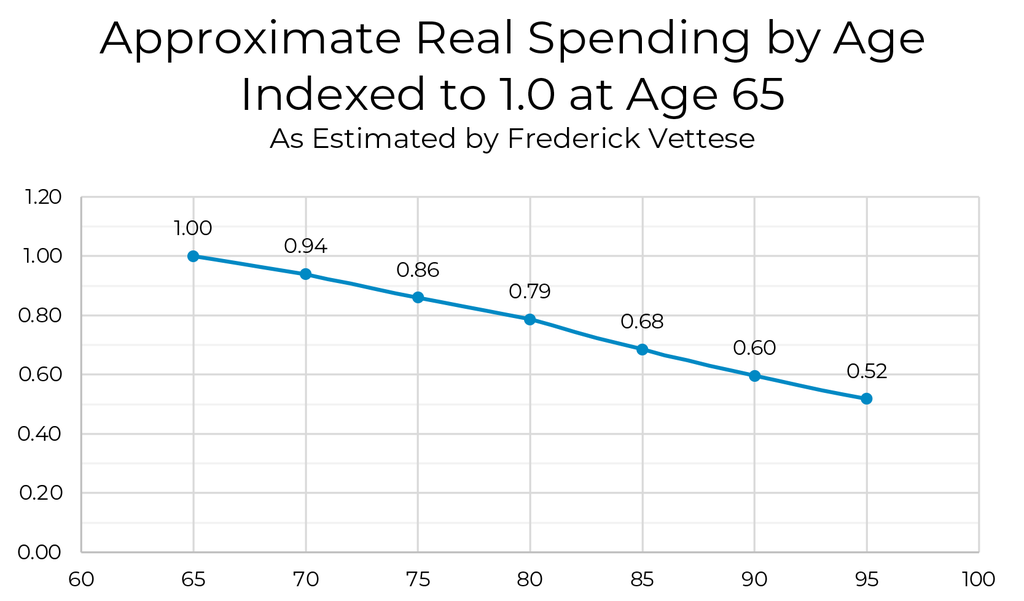
And here, I’ve translated those annual changes relative to a starting age of 65. Under these approximations, by age 90, retirees spend ~60% of what they did at age 65.
There’s Really No Spending Increase?
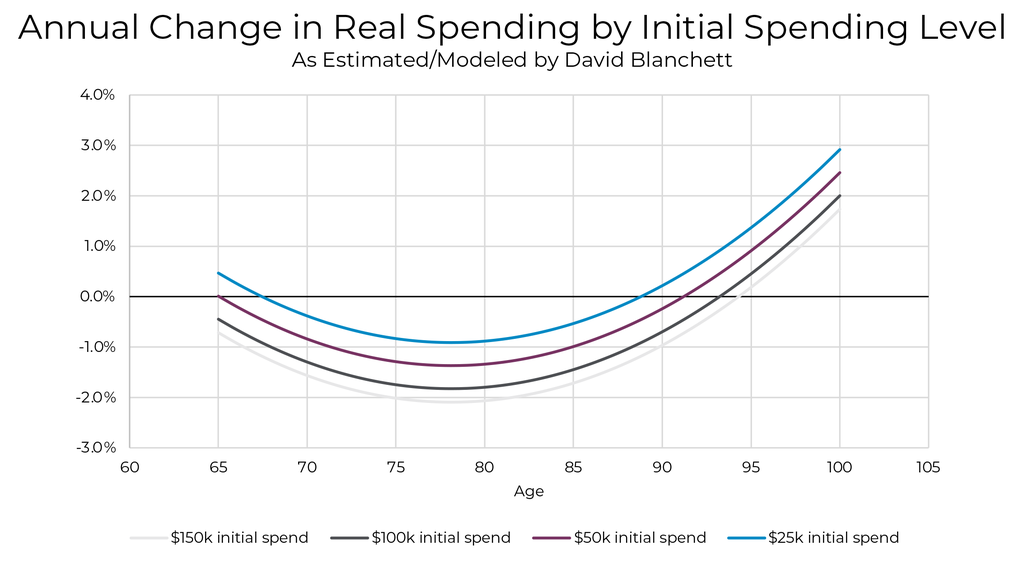
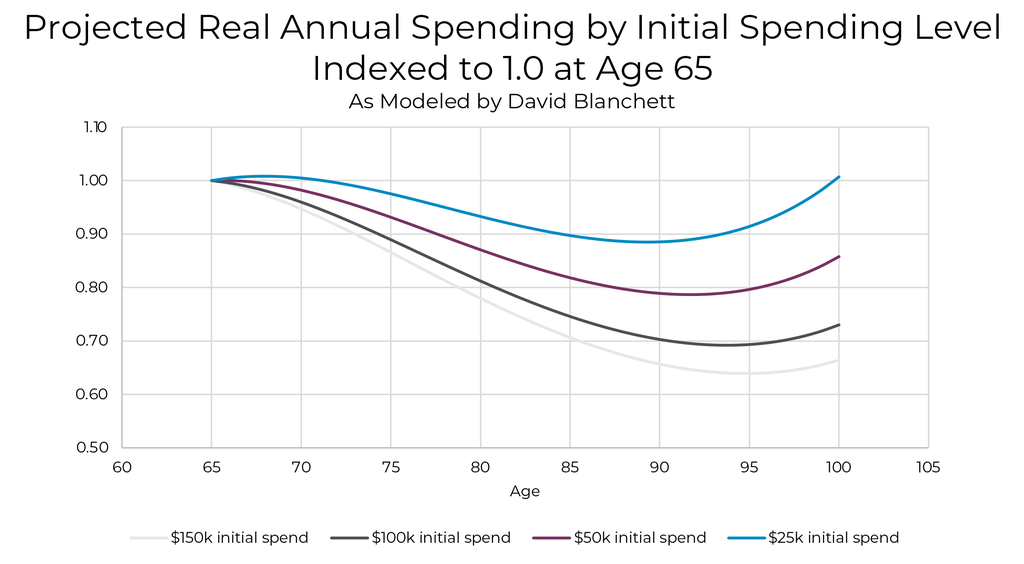
What about healthcare? Aren’t those costs drastically outpacing overall inflation, and don’t we all get sick and bankrupt ourselves? I refer back to my Great Manilow T-shirt Experiment analogy (the data just don’t support this concern). Yes, there’s an uptick in healthcare spending, but for many, those medical bills aren’t enough to raise spending overall. David Blanchett explored this potential uptick in a 2014 paper. 6 In it, he observes the “retirement spending smile,” which seems to indicate that retirees’ spending decreases at first and subsequently increases later in life with increased healthcare costs. This is contrary to the consistent spending decreases shown in Vettese’s findings. However, there are two things to clarify about Blanchett’s observed smile.
- The smile is largely on the rate of change rather than on the absolute spending, meaning spending might decrease at 2% for the first ten years and then only decrease by 1% for a few years (using arbitrary numbers to make my point). A chart of percentage changes, indeed, looks like a smile that dips and slopes back upward, but a chart of absolute spending would still be largely decreasing.
- The uptick is more pronounced for lower-spending households. I can’t say for certain why this happens, but intuitively, healthcare costs, particularly if they become extreme, would make up a much larger percentage of a smaller starting number.
Below, I’ve adapted and supplemented Blanchett’s tables from that paper. The first chart shows the percentage change in real spending by age for several starting spending levels. This is where the smile is most pronounced, but remember those are annual percentage changes. Absolute spending is only increasing when those lines are above zero. To make that clear, in the second chart, Blanchett used those percentage changes to model how absolute spending progresses through life after age 65 for several initial spending levels (and I’ve added the $150k spending line). Here, you see with higher initial spending levels, the uptick is not nearly as pronounced. It looks more like a soft landing than an abandoned landing.
Spend It While You’re Here (if You Want)
In the same way that being overly self-conscious about your Barry Manilow T-shirt may prevent you from showing it off, assuming spending will increase with inflation likely cheats you out of enjoying your money. In yet another study, Chris Browning et al. found that median wealth retirees under-consumed by about 8% relative to their spending ability, and the 20% of wealthiest retirees under-consumed their means by approximately 50%.7
As a financial advisor, my goal is not to get people to save every dime they possibly can for retirement. My goal is a comfortable retirement and otherwise help people maximize the utility from their money throughout their lives. If saving every dime is what gives you the most utility, great. If not, we need to have reasonable expectations about what we’ll spend, and therefore need, in the future, and that’s what I’m aiming to do with this article. I’m really just wanting people to wear their Barry Manilow T-shirts more often.
SOURCES
1 Thomas Gilovich, Victoria Husted Medvec, and Kenneth Savitsky, “The Spotlight Effect in Social Judgment: An Egocentric Bias in Estimates of the Salience of One’s Own Actions and Appearance.” Journal of Personality and Social Psychology, 2000, Vol. 78, No. 2, 211–222.
2 Sourced via https://fred.stlouisfed.org/
3 Based on 2024 data: https://www.bls.gov/cex/tables/calendar-year/mean-item-share-average-standard-error.htm
4 Sourced via www.longevityillustrator.org/
5 Frederick Vettese, “How Spending Declines with Age, and the Implications for Workplace Pension Plans.” CD Howe Institute, June 16, 2016.
6 David Blanchett, “Exploring the Retirement Consumption Puzzle.” Journal of Financial Planning, May 2014.
7 Chris Browning, Tao Guo, Yuanshan Cheng, and Michael S. Finke, “Spending in Retirement: Determining the Consumption Gap.” Journal of Financial Planning, February 2016.
This article is for educational purposes only and does not constitute personalized investment advice. Third-party research and data referenced are believed to be reliable but are not independently verified by Forum and may not reflect individual circumstances. Please consult your advisor before making any investment decisions.
By clicking on a third-party link, you will leave the Forum website. Forum is linking to this third-party site to share information in a different format and is for informational purposes only. However, Forum cannot attest to the accuracy of information provided by this site or any other linked site. Forum does not endorse the site sponsors or the information or products presented there. Privacy and security policies may differ from those practiced by Forum.