

Once again, the new year has started off a bit bumpy. The conflict in Iran has limited shipping through the Strait of Hormuz, impacting the price of oil and straining geopolitical relations. As rational investors, we know many similar events have happened in the past and markets endured. As humans, it is inevitable that we should ask: Should we get defensive to avoid the risk?
Our answer, as has been the case in every geopolitical crisis we’ve navigated alongside our clients, is to stay the course.
War Is Scary, But Eventually Markets Endure
It is natural to feel anxiety when conflict dominates the news. Markets can react to war with sharp, short-term declines as the news breaks. But the data tells a consistent story: In most cases, initial downturns tend to be followed by reasonable market returns.
The chart below, which we shared previously when Russia invaded Ukraine, shows how global markets have responded to conflicts. In most cases, the 6-month return was positive. In 10 out of the 11 events, with World War II being the exception, the 3-year returns were positive and often strongly so.
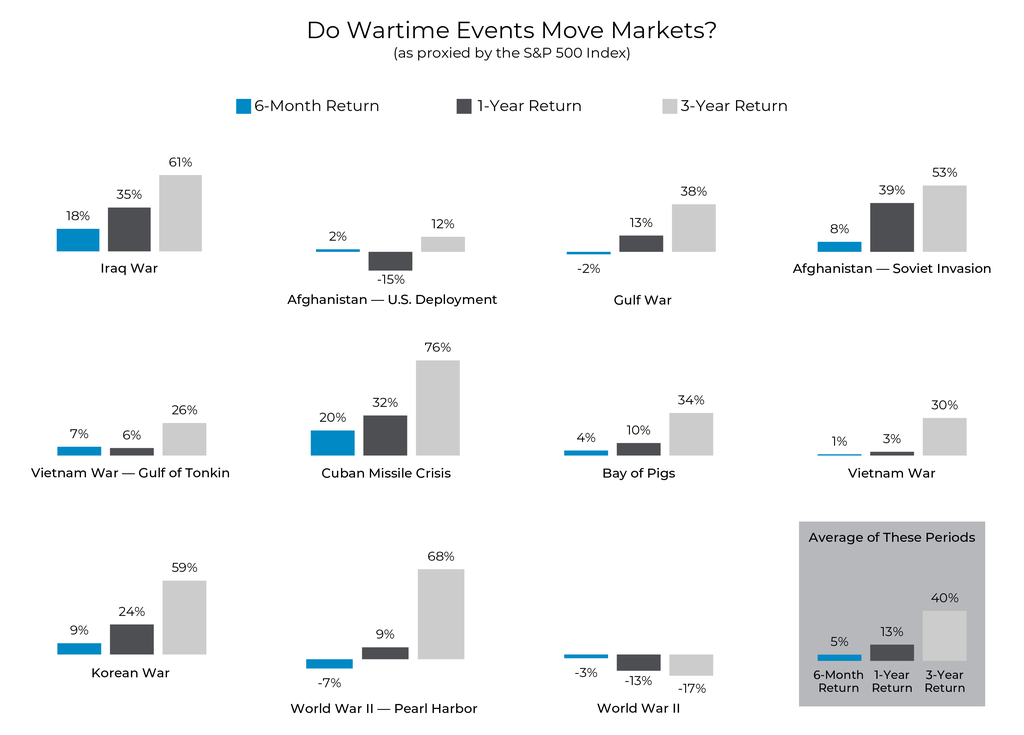
The lesson here is not that war is good for markets. It is that markets price in war-related events rapidly, may get bumpy, and eventually look ahead to recovery. By the time you are reading about a conflict in the news and worrying about its economic effects, that information is already being rapidly priced into today’s stock prices. Selling at lower prices means locking in the decline and risking missing the recovery.
Why Global Diversification Matters So Much
One of the themes we have emphasized repeatedly with clients in the past several years has been the importance of global diversification. The current conflict is a powerful real-world illustration of why.
Investors with portfolios concentrated in US large-cap growth stocks have been feeling a bit more pain in 2025 and into 2026. While a diversified portfolio certainly has not been immune to the volatility, the diversification across international stocks, value stocks, small-cap stocks, and bonds has helped cushion the blow.
This is not a new theme. In our February 2025 piece, we explored how US large-cap growth stocks had become historically expensive and how the recent outperformance had been driven primarily by valuation expansion (i.e., paying more per dollar of earnings) rather than earnings growth alone. Due to high US Large Growth valuations, we suggested US stocks are likely to have lower returns than international stocks in the next 10+ years. The future continues to look bright for globally minded investors.
Volatility a Toll, Not a Stop Sign
One of the most difficult truths in investing is that the very thing that makes stocks rewarding over the long run only exists because of periods like this one. If stocks always went up in a straight line, everyone would own them, and the premium would disappear. The discomfort of a downturn is not a flaw in the system. It is the system working as intended. The investors who earn the premium are the ones willing to stay seated through the bumps.
Consider an analogy: Imagine you are offered a job that pays significantly more than your current one, but the commute is longer and occasionally hits traffic. You would not quit every time you sat in a traffic jam; you took the job knowing the commute was part of the deal. Volatility is the commute. The destination is the long-term compounding of wealth that has rewarded patient investors for over a century.
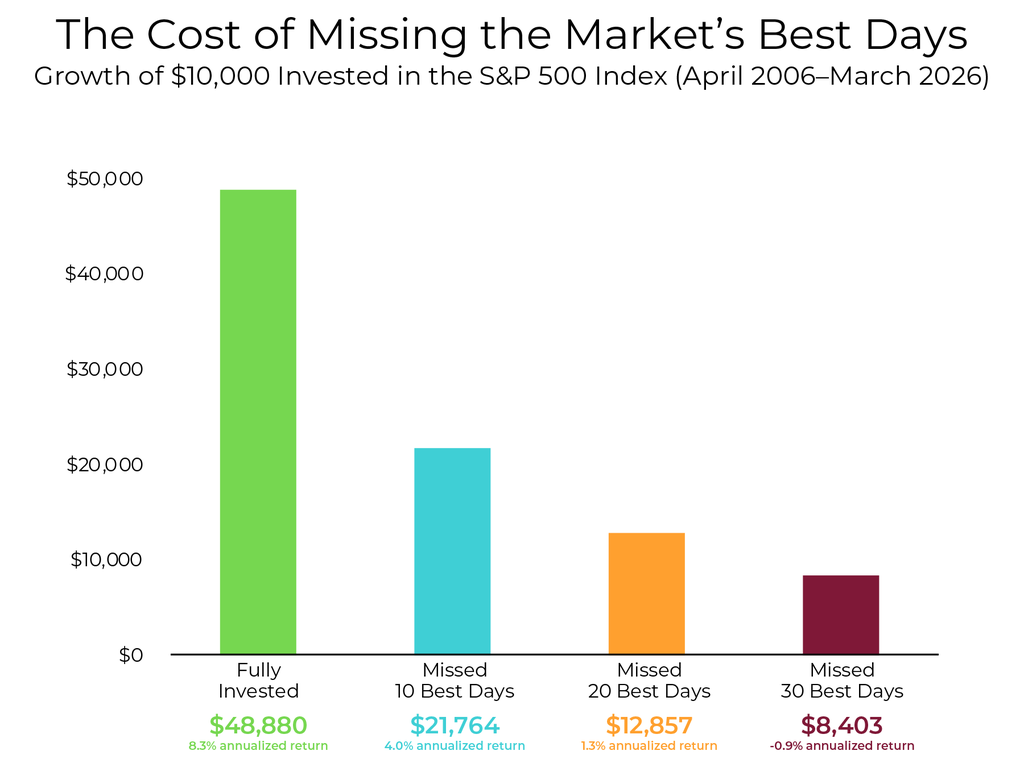
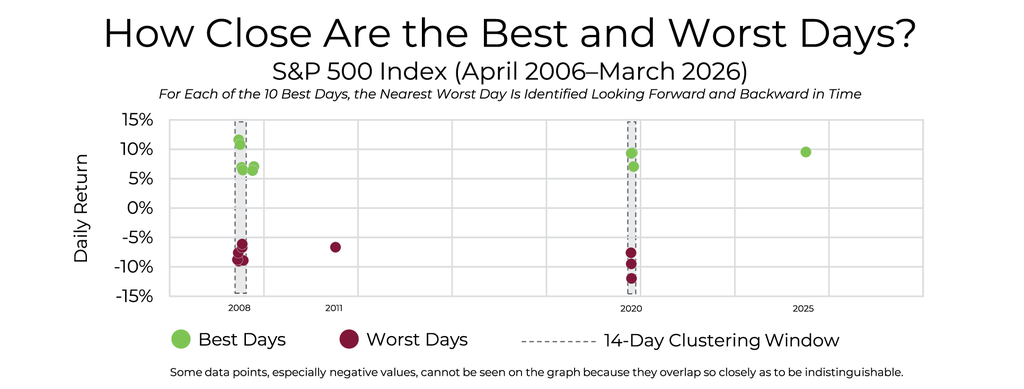
Research supports this intuition. Studies have consistently shown that the majority of the stock market’s long-term returns come from a surprisingly small number of trading days. Missing just a handful of the market’s best days over a 20-year period can cut your total return nearly in half.1 The best days also tend to cluster near the worst ones, with 6 of the market’s 10 best days happening within two weeks of one of the 10 worst days, when looking back at the past two decades.2
The cost of trying to avoid the pain is almost always greater than the pain itself.
Staying the Course Grows Wealth Over a Lifetime
The conflict in Iran may continue to dominate headlines for weeks or months. Oil prices remain elevated, supply chains are being disrupted, and there are legitimate concerns about a broader economic impact.
But if history is any guide, and we believe it is, the best course of action for long-term investors is to remain disciplined, diversified, and invested. The discomfort you feel today is the cost of earning the premium that markets have rewarded over time.
SOURCES
1 S&P 500 (^GSPC) adjusted market close (net div.) daily price data via Yahoo Finance. 5029 trading days. “Missing” a day means receiving 0% return instead of the actual daily return.
2 S&P 500 (^GSPC) adjusted market close (net div.) daily price data via Yahoo Finance.